Canvassing software for municipal campaigns.
Door knocking, lawn signs, lit drops, GOTV, and a vote estimate from your 4/5 rate. Offline on a phone. Free while in beta.
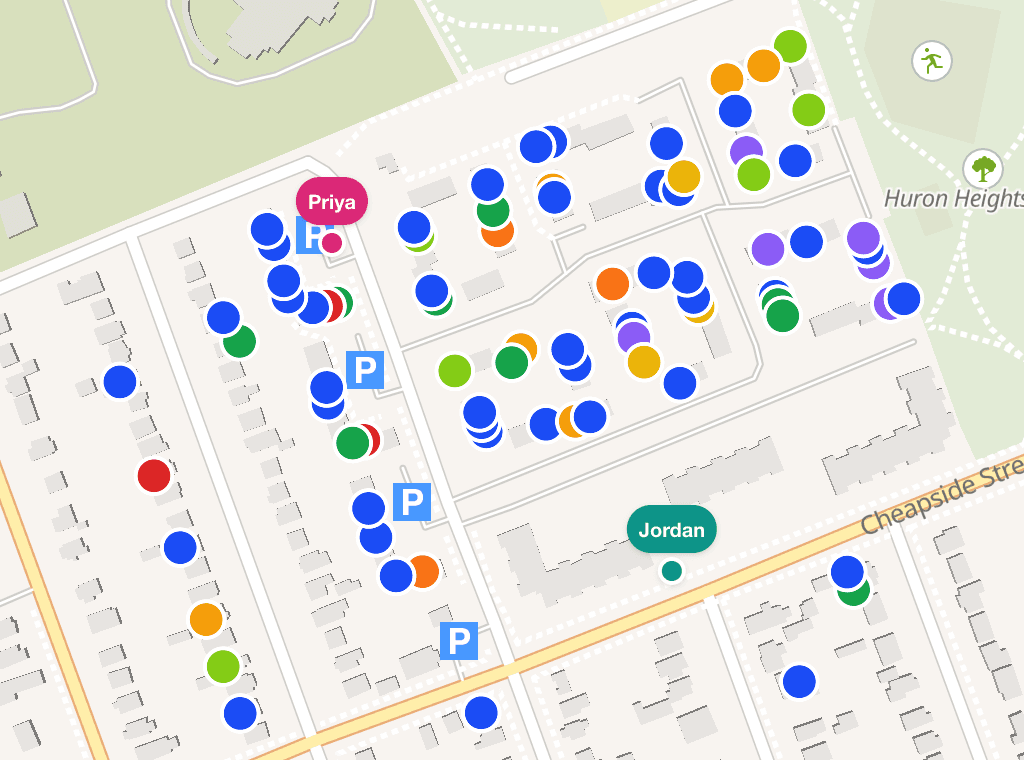 Real screenshot, demo turf
The canvasser app
Log in with a phone number. Doors on a list and a map. One sheet per knock. Teammates show on the map. Save it to the home screen and it opens full screen.
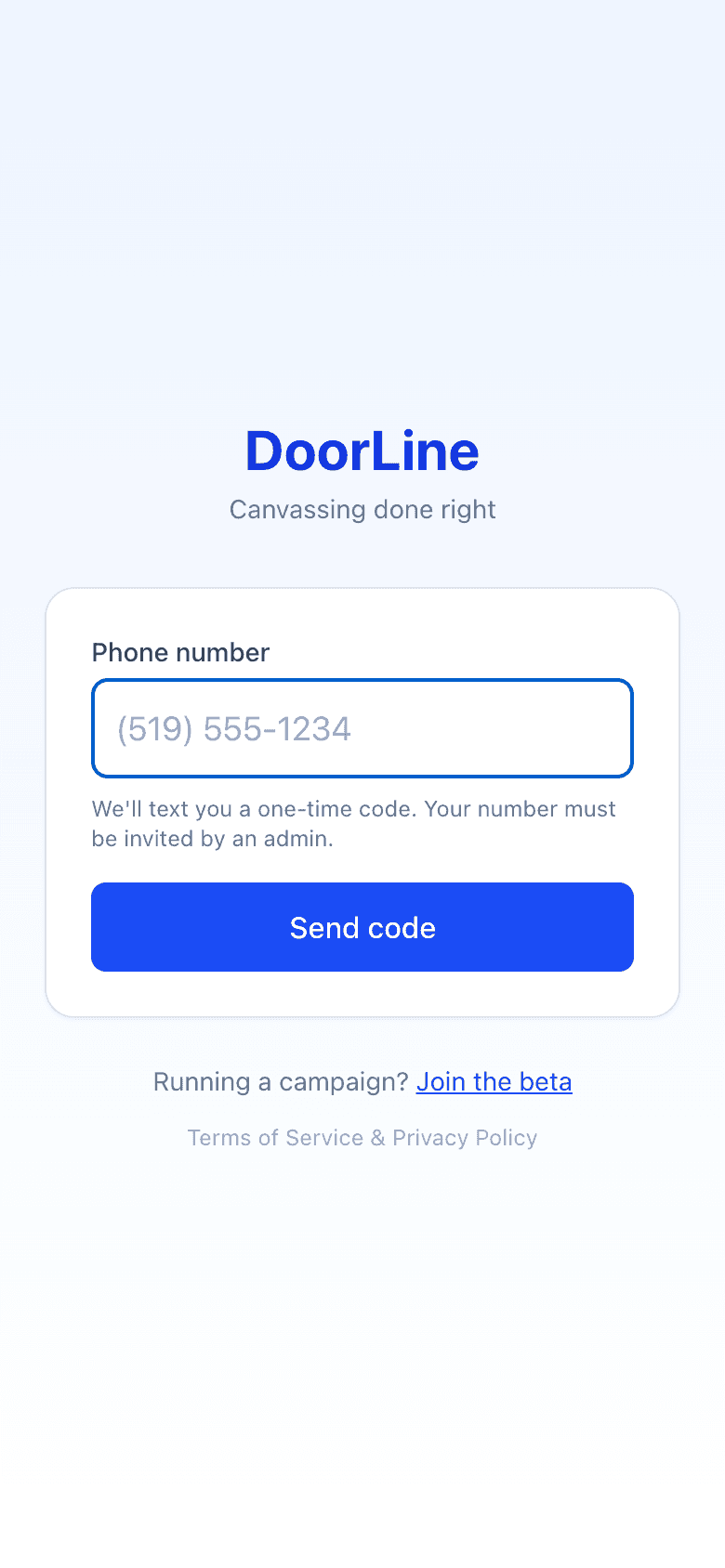
Log in with a text
No passwords, no app store, no IT night. Volunteers get a code by text and they're knocking.
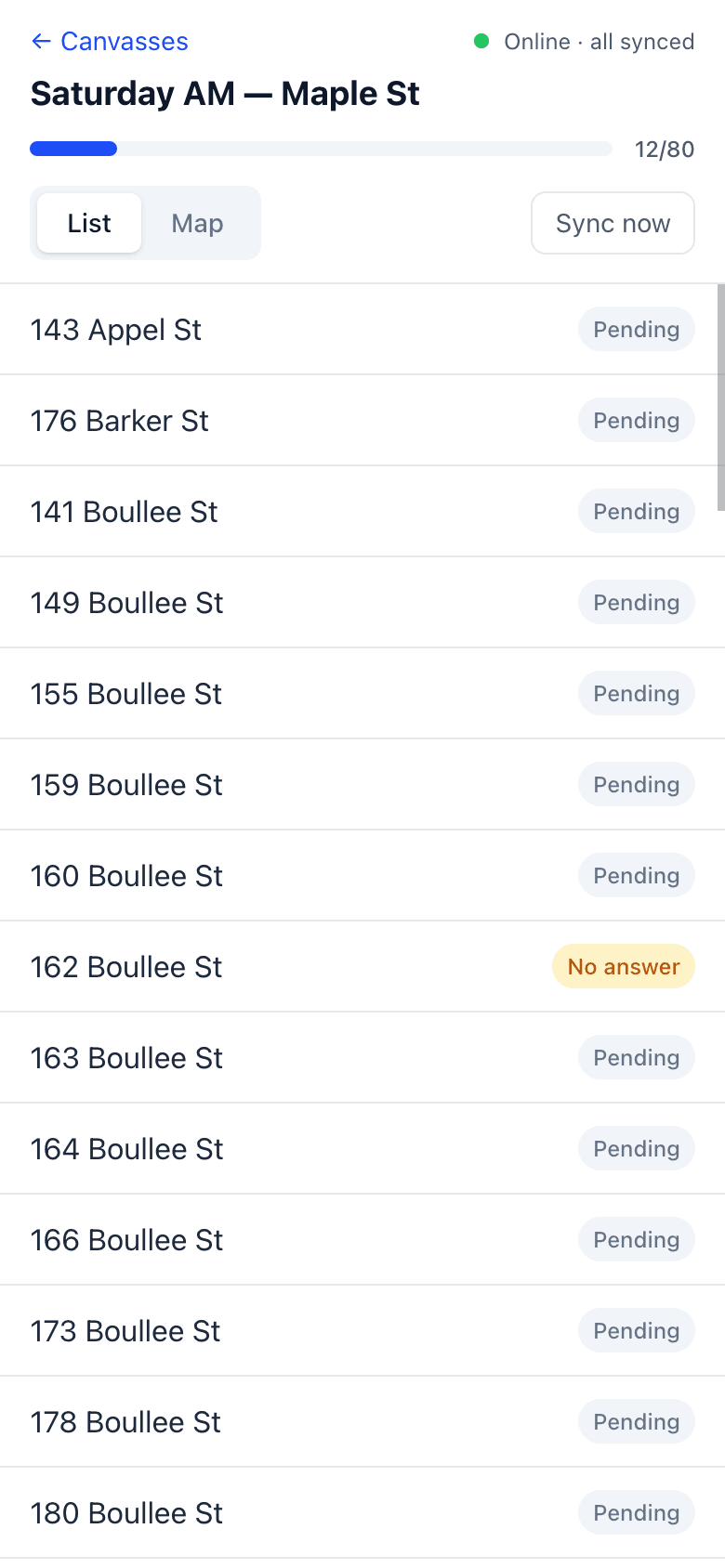
Every door, in walking order
The turf as a simple list, sorted the way you'd walk the block, with each door's status at a glance.
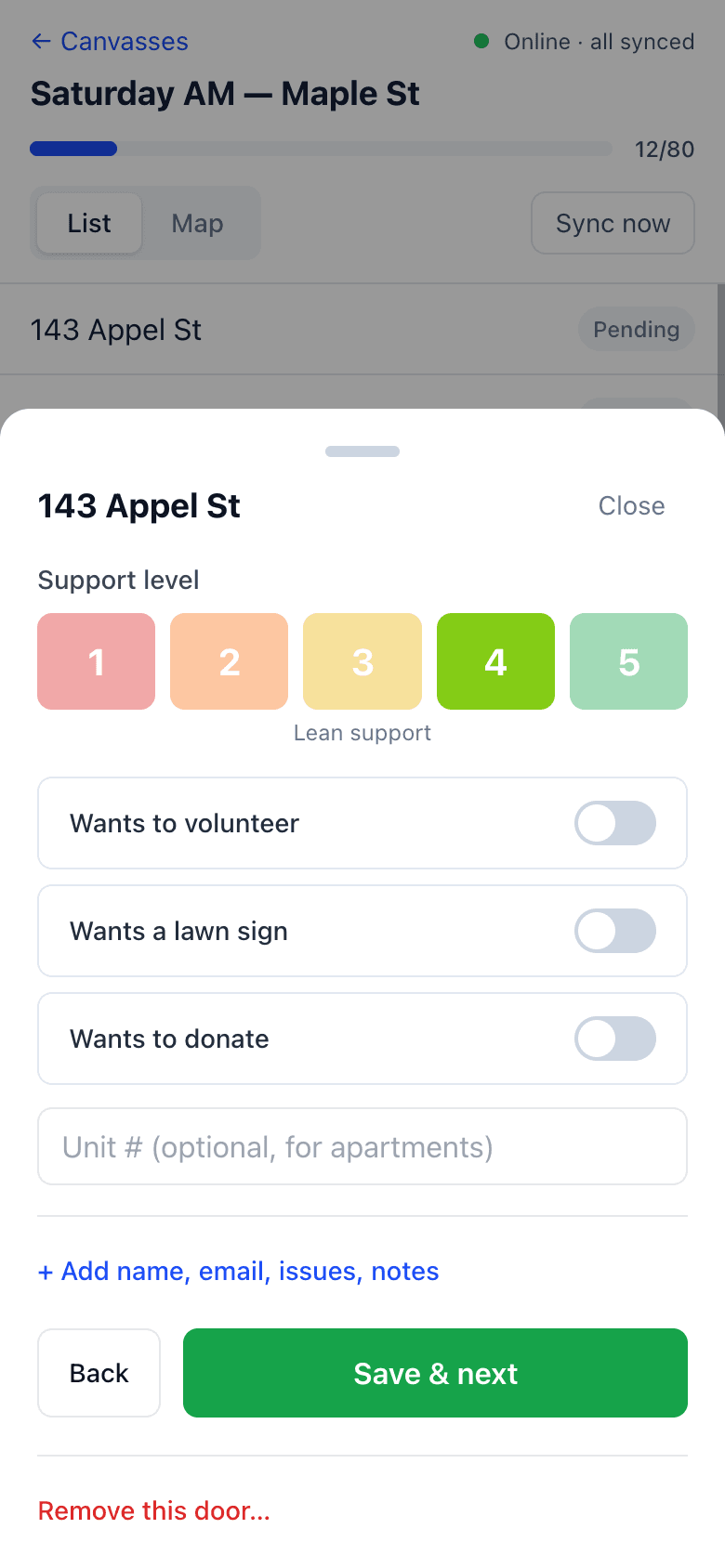
One sheet per knock
Tap an outcome, tap a support level, done. Signs, volunteers, and notes are one more tap.
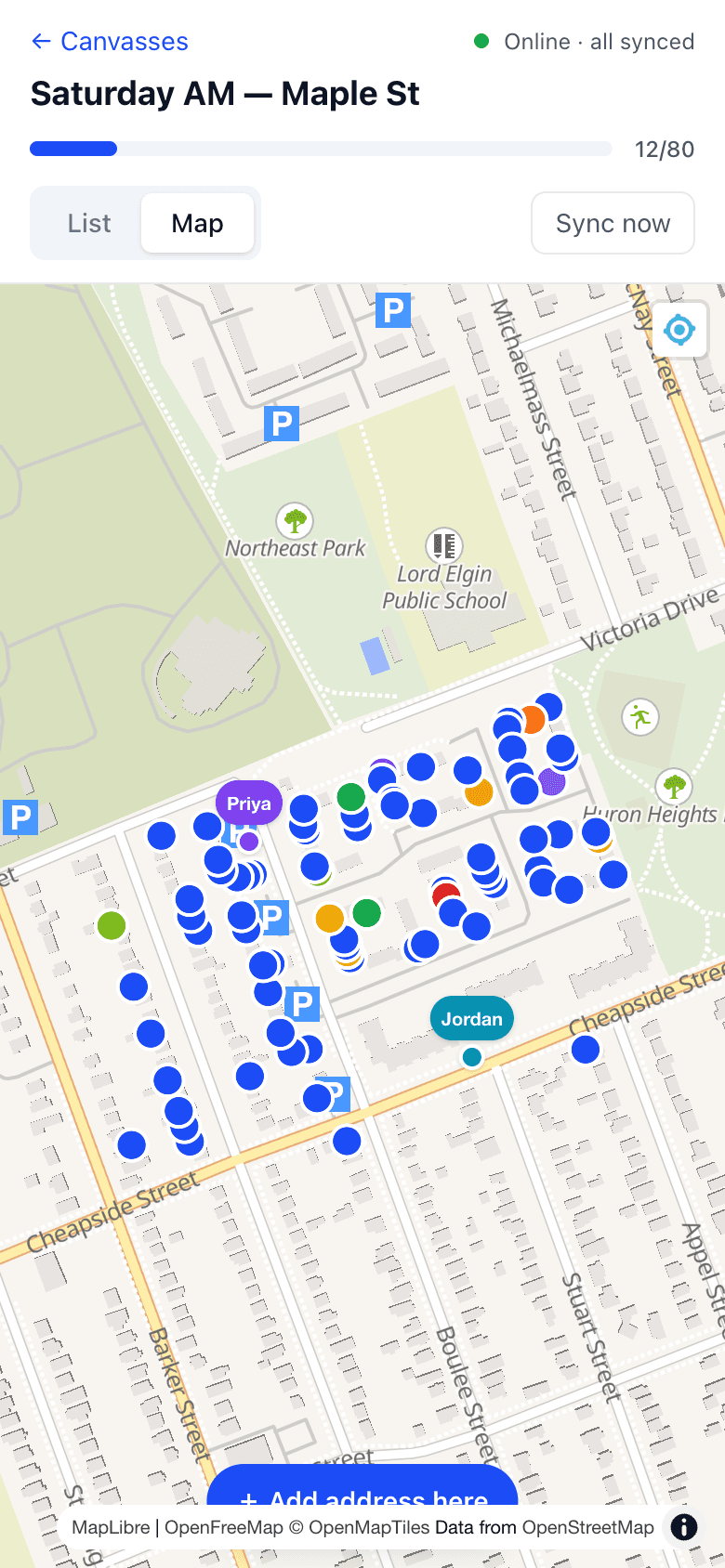
Live map & teammate GPS
Colored pins for every door, plus Priya and Jordan moving on the map in real time.
What is in the product
Field operations for a municipal campaign, in one place. Demo figures below are invented.
Signs
Requests, a public form, and a crew map
Residents request a sign on your website or from a QR code on the board. Each request is confirmed by email, then sits on one list: to install, damaged, installed, or waiting on that confirm. The sign team opens a phone map of the work queue — not every board already in the ground.
- Public form you can embed. Typeahead stays inside the ward.
- Live email or text to the crew when a request lands, with a link to mark it Installed.
- Split a Saturday into sign turfs, or schedule teardown for after the polls close.
14 Pine Street
Small · requested by A. Chen
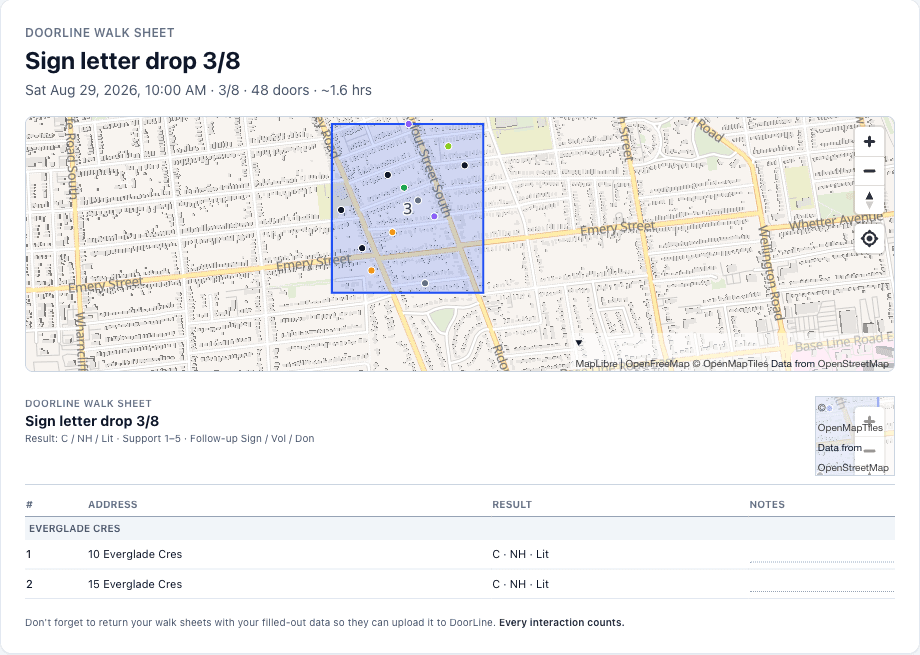
Lit Drop & worksheets
A sparse list, split into driving packs
Upload a spreadsheet, filter doors you already IDed, or click the map. Preview the split, drag the polygons, then print sheets. Split into N lists, or cap each list at N doors (packs of 50, packs of 100). Manual Input reads the filled sheets — In / Dmg / Skip, or C / NH / Lit — and writes back to the same doors.
Lit Drop guide →GOTV
Election-day lists from your 4s and 5s
The target list is built from the latest answered door at each house. Add advance-poll and election-day dates to project how many vote IDs you will have by then. Then the same split tools as Signs: list, map, preview polygons, packs of N doors. Volunteers mark Contacted, Voted, or Not home. Voted doors leave the list.
GOTV guide →| Address | Lvl | Status |
|---|---|---|
| 22 Maple Ave | 5 | Not yet contacted |
| 8 Oak St · Unit 2 | 4 | Contacted |
| 401 King St | 5 | Voted |
doorline.dev/s/…
PNG or SVG for flyers and the back of the sign.
<iframe src="https://doorline.dev/s/…"
  style="width:100%;border:0"
  title="Request a lawn sign"></iframe>
Public form
Embed the request form. Print the QR.
One permanent link per campaign. Paste the snippet into NationBuilder, Squarespace, or WordPress. Colours match your site. The same URL is the QR code. Confirmation is email, so junk requests do not land on the install map.
Form and embed →Canvassing
Offline knocks, a live team map, paper if you want it
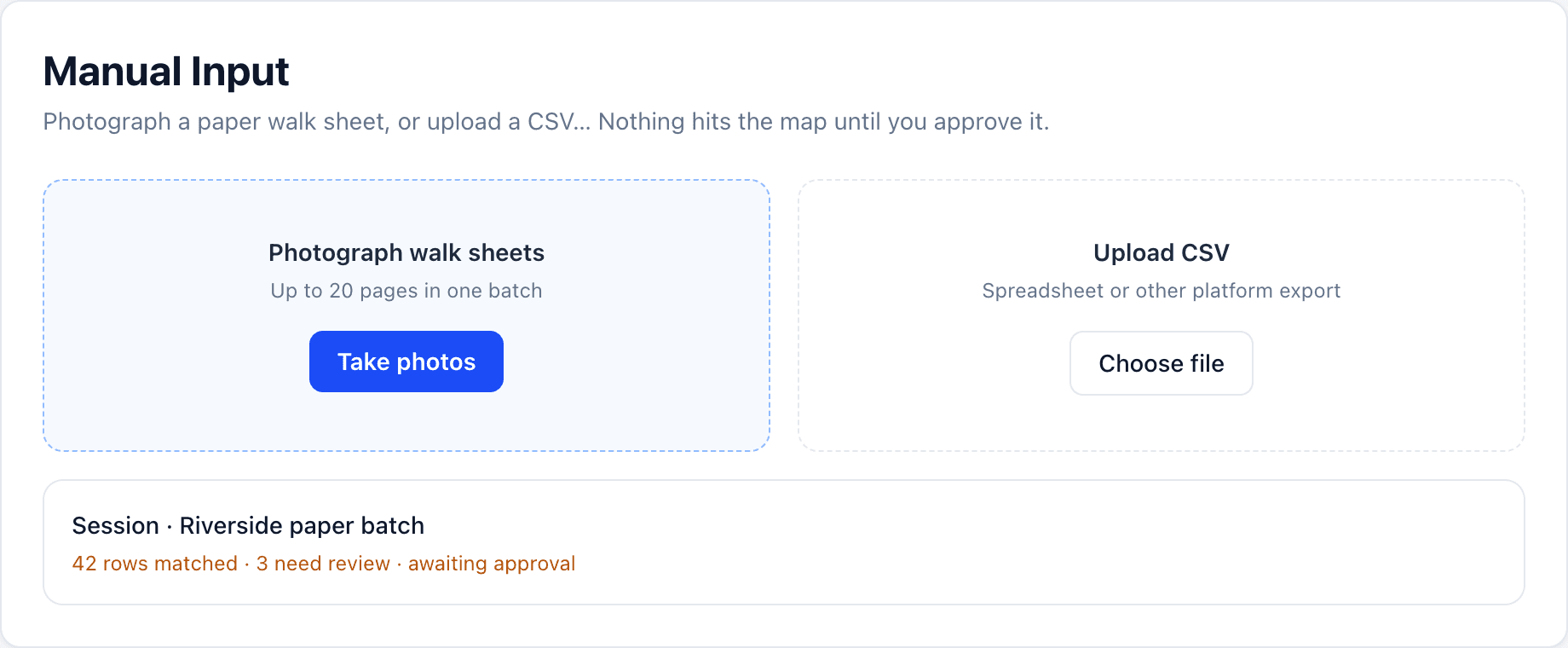
Cut turfs, schedule a canvass, invite by phone number. Volunteers save DoorLine to the home screen. Knocks store on the phone and sync when signal returns. Captains see live GPS. If someone works from paper, photograph the sheet — up to 20 at a time — and review the matches.
Pricing
You know the routine with campaign software: an entry price that balloons once you're locked in, per-seat charges for volunteers (volunteers!), add-ons for things that should be buttons, and an export fee to get your own data back.
Every dollar you give a software vendor is a dollar not spent on lawn signs.
DoorLine is free while it's in beta. After that it will be priced to cover hosting. No per-volunteer seats.
What a month of field software costs
Take it for a spin
Sample campaign data, same charts as admin. Invented names.
Support distribution
Every answered door, bucketed 1–5. Know your base, find your persuadables.
Doors per week
Weekly knock volume from the same charts as admin.
The leaderboard
Weekly doors. Optional badges.
Vote estimate and issue analysis
Answered doors become two numbers campaigns actually use: how many votes you are on track for, and what people are talking about at the door.
An election-day vote estimate from your 4/5 rate
Every answered door gets a 1–5 support level. The model takes your ward's electorate and expected turnout, measures your 4–5 support rate (weighting recent weeks more heavily, because opinions move), counts undecideds at that same rate — not as if they all become yours — and projects the votes you'd bank if the election were today.
- ✓Recency-weighted support rate, so a rough June doesn't drown out a strong September.
- ✓A margin of error built from how much your canvasses disagree and how much of the ward is still unseen — honest about how sure it is.
- ✓Plotted against the win line (50% + 1 of expected votes cast), so the chart answers the only question that matters.
Electorate, expected voters, your base, the undecided break, and the projected tally versus the win line.
AI that reads the door notes so you don't have to
Canvassers scribble gold into the notes field ("worried about the arena project", "rent went up again") and it usually dies there. DoorLine's natural-language analysis reads every note and issue tag, builds an issue taxonomy specific to your campaign, and keeps it current as new doors come in.
- ✓See which issues dominate your ward, and which are rising month over month.
- ✓Steer it with plain-language instructions ("file potholes under road maintenance").
- ✓Personal information is stripped before any text is analyzed. Names, addresses, and contacts never leave your database.
What the ward actually cares about, and how it shifts over the campaign. Housing starting to spike? Now you know before your opponent does.
Volunteer knocking today?
No passwords, no app store. Your phone number and a text code.
Also included
Same account. No add-on tiers.
Works offline. Actually.
Basements, stairwells, dead zones: every knock saves on the device and syncs the second you get bars. Nobody loses an evening of doors to a spinner again.
Live team map & GPS safety
Watch your whole team move across the map in real time. Volunteers feel safer, captains spot who's stuck, and nobody knocks the same door twice.
Vote estimate and field analytics
Support distribution, weekly pace, coverage, and a vote model that projects your election-day tally against the win line from your 4/5 rate.
Issue analysis from door notes
Reads canvasser notes (personal info stripped first), builds an issue taxonomy for your ward, and shows which issues are rising month over month.
Paper & CSV, digitized
Photograph old walk sheets, up to 20 at a time, or drop in a CSV from a spreadsheet or another platform. AI reads it, matches every row to a real address, and queues it for review.
Weekly badges and a leaderboard
Automatic weekly badges and a podium of doors knocked. Individuals can opt out.
Turf cutting in minutes
Draw a shape, see the door count and time estimate as you draw, and schedule the canvass in the same dialog. That's the whole workflow.
Signs, start to finish
A public request form with a QR code, every request on one map, live texts or emails for the sign captain, a standing crew view for dribs and drabs, and an optional weekend deploy — plus teardown after election day.
GOTV that knows who your supporters are
Every 4 and 5 you IDed becomes a get-out-the-vote target. Add advance-poll and election-day dates to see how big that list is likely to be. Split across teams, tap once when someone has voted.
Your data leaves whenever you want
One-click NationBuilder-compatible CSV export. No export fees, no 'talk to sales', no hostage negotiation. It's your data.
Why I built this
I'm Matt. I manage campaigns. I have personally watched a volunteer lose an entire evening of doors because a "market-leading" canvassing app couldn't survive ten minutes without signal. I have personally read the invoice that charged us for the privilege.
The big platforms are priced for national parties and built to keep your data inside their walls. Municipal campaigns, the volunteer-run, shoestring ones that actually change neighbourhoods, get the same bill and none of the leverage.
So I built the thing I wanted on the doors: offline-first, live team map, real analytics, one-click export, and an AI that reads your old paper walk sheets so that data stops dying in a binder. Then I priced it like a grudge.
I'm not here to make money. I'm here to cover costs and make this category embarrassing to overcharge for.
The canvasser view. Works on the $150 phone in your pocket.
Mid-campaign? Switching takes an afternoon, not a migration.
Start knocking today and bring your existing data over whenever you're ready, whether it lives in a binder, a Google Form, a spreadsheet, or another platform. Imports are matched to real addresses and deduplicated automatically, so nothing lands twice.
Paper walk sheets
Photograph them, up to 20 at a time, and AI transcribes the handwriting and matches every row to a real address. You review, it lands on the map.
CSV from anywhere
Export from your old platform or that homegrown spreadsheet tracker, drop the CSV in, and AI figures out the columns. No template to fill out.
And back out again
One-click NationBuilder-compatible CSV export whenever you want it. Easy in, easy out. That's the point.
The pricing page
Free while in beta. Eventually: cheap. That's it. That's the whole pricing page.
And to be clear about what happens after the beta: if you join now, this campaign stays free for its whole run, and your next one will be super cheap. We are not going to jack up the price on the people who helped us build this. No card, no countdown, no lockout.
Join the free beta